
Search the research desk.
Type a market, company or commodity and jump straight into the K2 report that covers it.
K2 Capital is a Hong Kong-based investment firm and a trusted channel to East and Southeast Asian investments, delivering disciplined strategies and customized portfolio solutions.
Opportunity moves across borders. K2 Capital, a trusted channel into East and Southeast Asian investments.
K2 Capital Limited · Hong Kong, China
[ What we do ]
From equities and natural gas to venture capital and franchising, across Mainland China, Hong Kong and Southeast Asia.
Read the research[ Portfolio ]
Funds, ventures and an institute across asset management, artificial intelligence, F&B and education.
Equity, commodity and thematic research from the K2 research team, on markets across Asia and beyond. Selected reports are open to everyone; clients get full access to every report.
Type a market, company or commodity and jump straight into the K2 report that covers it.

Partnerships, advisors, funds and portfolio news from K2 Capital and its companies.
Clients & recognition

[ Portfolio ]
From franchise licensing and F&B ventures to fund raises and AI acquisitions. Hover a row for a preview, select it to read the release.
[ Global Research ]
by K2 Capital Management
Gateway to strategic investment insights across Asia and beyond. Become a client to gain full access to every report.

[ News & Insights ]
by K2 Capital Management
Stay up to date with our latest news and insights.

[ Aether portfolio ]
[ Accelerators, partners and competitions ]
Press releases featuring Oliver Tedja and the firms he co-founded.
K2 Capital is advised by leaders from listed companies in China and from global financial services.

[ Contact ]
K2 Capital Limited, Hong Kong. Tell us what you are working on and the right person will get back to you.
Equities
Beyond Meat’s turnaround prospects remain constrained by high leverage, waning consumer demand, and a shrinking investor base.
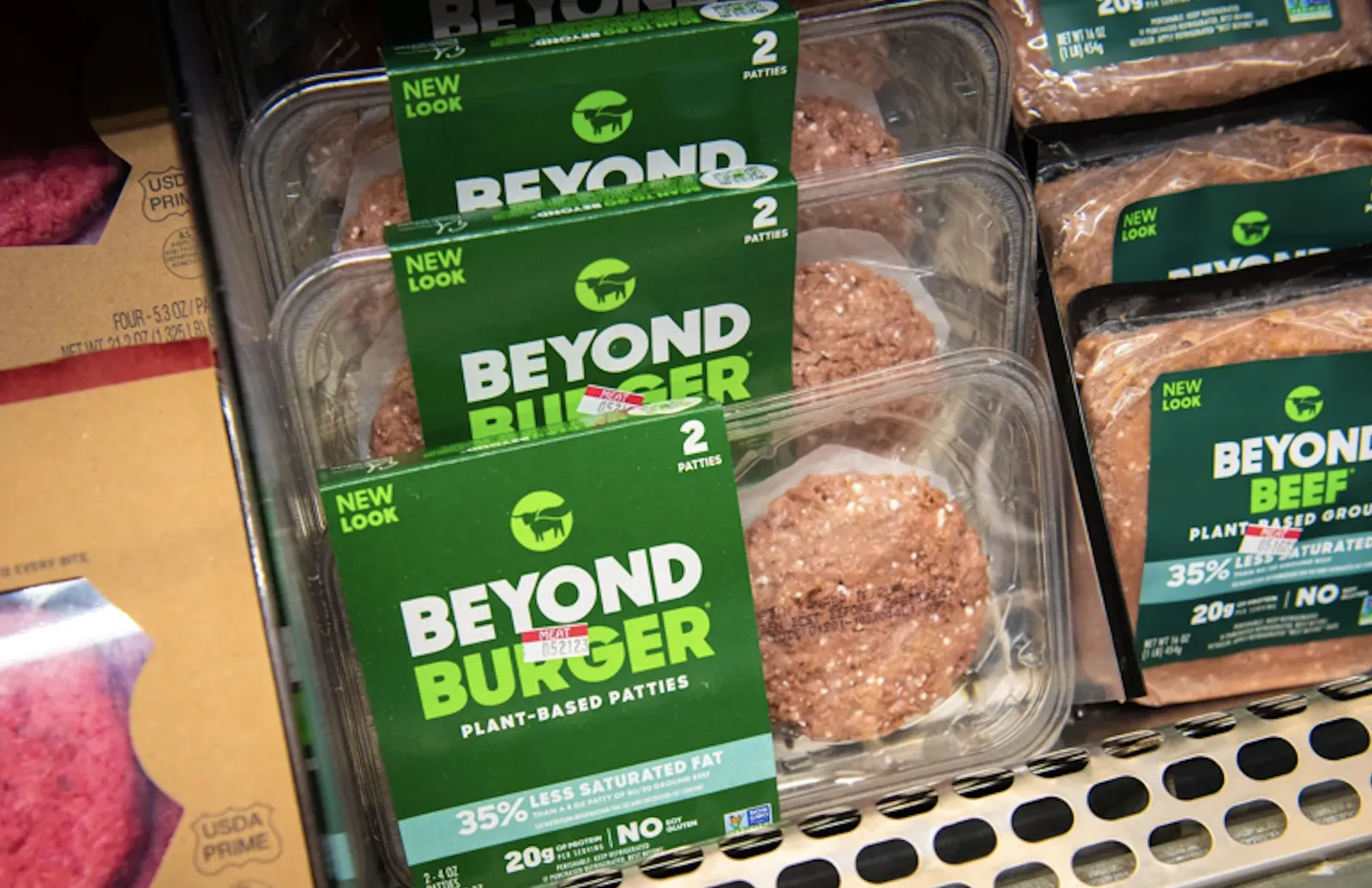
Beyond Meat’s recent price surges were fueled by short-squeeze momentum and inclusion in the Roundhill Meme Stock ETF, with trading volume exceeding 2 billion shares, over 50x the daily average of 37.7 million before collapsing 68% post–debt swap announcement, mirroring prior meme stock corrections. ( 24/7 Wall St. )
The company’s US$1.2 billion debt load against US$117.3 million in cash underscores solvency risk, even after an US$800 million debt reduction through convertible notes and a US$100 million secured loan carrying 12–17.5% interest and warrant coverage. ( AP News, TheStreet )
Net revenue fell 19.6% YoY in Q2 2025 to US$75 million, with U.S. retail down 36.7% and international foodservice plunging 35.8%, reflecting declining consumer demand and weaker QSR partnerships. ( Beyond Meat, Inc. )
Venture capital investment in plant-based startups dropped 64% YoY to US$309 million, driven by concerns over ultra-processed food narratives and inflationary cost pressures impacting consumer willingness to pay premium prices. ( Green Queen )
Despite a return to 17.7% gross margin from a prior -9.6%, Beyond Meat’s volume sales declined 7.1%, indicating early efficiency gains without underlying demand recovery. ( Investing )
The global plant-based food market continues to expand rapidly, reflecting strong policy and consumer momentum toward sustainable and ethical consumption. Market size is projected to grow from US$56.99 billion in 2024 to US$64.14 billion in 2025, achieving a 12.5% CAGR, with long-term forecast indicating US$108.55 billion by 2029 at a 14.1% CAGR. Growth is supported by health awareness, climate change consciousness, and the expanding vegan and flexitarian populations. However, this forecast was slightly downgraded by 0.2% due to rising trade tensions and tariffs between the U.S. and key partners such as Canada and China – particularly affecting inputs like pea protein and textured vegetable protein. ( The Business Research Company )
In the U.S., retail sales of plant-based foods have more than doubled since 2017- from US$3.9 billion to US$8.1 billion in 2024, according to SPINS and Good Food Institute (GFI). Yet, the market faced headwinds in 2023-2024, as unit sales fell 5% and dollar sales 4%, pressured by inflation, high plant-based product prices, and weaker consumer engagement. The industry’s ability to sustain growth now hinges on improved taste, price competitiveness, and convenience, aligning with evolving consumer expectations ( GFI )
Globally, sales remained resilient, rising 5%YoY to US$28.6 billion in 2024 despite U.S. softness. Non-dairy alternatives led with US$22.4 billion (+5%), while meat analogues reached US$6.1 billion (+4%). Europe dominated the market at US$9.7 billion, followed by Asia-Pacific (US$8.9 billion and North America (US$7.3 billion) – where regular beef sales hit record highs.( Green Queen )
Meanwhile, the regulatory and capital environment for alternative proteins has tightened. Venture capital investment in the climate tech food sector fell 27% YoY to US$1.1 billion in 2024, with plant-based startups raising only US$309 million, a 64% drop due to investor caution around ultra-processed food narratives. Cultivated meat funding also declined by 40%, whereas fermentation-bassed protein technologies grew 43%, marking a potential regulatory and funding shift toward less processed and more sustainable solutions. ( Green Queen )
Beyond Meat reported Q3 2025 revenue of US$81 million (+7.6% YoY), slightly beating consensus estimates of US$80.1 million, with an EPS loss of US$0.41 vs the expected -US$0.48. However, the stock declined as investors viewed the modest growth and 7.1% decline in product volumes as underwhelming. Growth in U.S. retail (+14.6%) and foodservice (+15.5%) partially offset weakness in international foodservice (-17.2%). The company’s gross margin turned positive at 17.7%, up from -9.6% YoY, and net loss narrowed to US$26.6 million from US$70.5 million, signalling operational efficiency gains. ( Investing )
To strengthen its balance sheet, Beyond Meat executed a US$800 million debt reduction, swapping 2027 convertible notes for US$202.5 million due 2030 and announcing the issuance of up to 326 million new shares, which sparked dilution concerns. Despite avoiding near-term debt maturities, the firm faces a heavy US$1.2 billion debt burden with only US$117.3 million in cash, heightening liquidation risk. ( AP News, TheStreet )
Volatility intensified after Walmart expanded Beyond Meat’s product distribution to 2,000+ stores, triggering a 700% short-squeeze-driven surge, followed by a sharp correction. The rally was amplified by retail investors and the inclusion of BYND in the Roundhill Meme Stock ETF, mirroring GameStop-like momentum rather than fundamentals. ( Benzinga, Green Queen )
Despite the temporary market hype, operational issues persist. BYND continues to burn cash, with revenue stagnation and insufficient scale to offset operating expenses. Analyst warns that without sustainable volume growth or margin expansion, the firm’s turnaround plan – aimed at achieving EBITDA – positive results by H2 2026. ( GreenQueen, Seeking Alpha )
Beyond Meat’s Q2 2025 net revenues fell 19.6% YoY to US$75 million, driven by an 18.9% decline in sales volume and 0.9% drop in net revenue per pound. The contraction reflected weakened category demand, fewer U.S. retail distribution points, and lower QSR sales internationally. The company’s U.S. retail segment, its largest market, recorded a 36.7% decline to US$32.9 million, pressured by a 24.2% fall in volume and 3.2% lower pricing due to trade discounts and softer consumer demand. ( Beyond Meat, Inc. )
In contrast, U.S. foodservice revenue rose 6.8% to US$11.1 million, supported by price increases and improved mix in ground beef and dinner sausage offerings. Meanwhile, international retail sales dropped 9,8% to US$15.9 million, primarily from lower burger and sausage demand in Canada and the EU, partially offset by favorable FX movements and price adjustments. The international foodservice channel saw the sharpest contraction, declining 35.8% to US$15.1 million with a 21.6% volume drop tied to reduced orders from major QSR clients. ( Beyond Meat, Inc. )
Beyond Meat’s recent stock volatility underscores the risks of speculative trading detached from fundamentals. The company’s inclusion in the Roundhill Meme Stock ETF and heightened social media attention sparked a short-lived rally resembling 2021’s meme stock frenzy. During the surge trading volumes exceeded 2 billion shares-over 50x the daily average of 37.7 million, fueled by short squeezes and gamma-driven momentum. However, such rallies are inherently unstable; following the debt-swap announcement revealing fragile finances, BYND plunged 68% in a week, mirroring prior collapses of meme-driven assets. This volatility highlights how market sentiment – rather than business performance – continues to dictate BYND’s short-term valuation. ( 24/7 Wall St. )
Beyond Meat’s underlying challenges remain structural. Despite early enthusiasm from celebrity investors (Bill Gates & Leonardo DiCaprio) and partnership with major brands, U.S. consumer demand remains weak, constrained by taste concerns,complex ingredient profiles, and inflationary pressures. Efforts to diversify products, such as a “healthier” burger formula in 2024, failed to revive domestic sales, while operations in China were suspended due to poor performance. Stronger traction in Europe – where McDonald’s offers Beyond products – has not offset declining U.S. momentum. The company’s strategic pivot to broaden its ‘Beyond’ brand beyond meat substitutes aims to regain relevance, but execution risk remains high. ( AP News )
The company’s mounting US$1.2 billion debt and deteriorating liquidity – evidenced by supplier payment delays rising from 8 to 19 days YoY compared to the industry average of 12 days – signal severe cash flow constraints and growing credit risk for vendors and lenders. ( Food Dive ) In response, Beyond Meat secured a US$100 million senior secured loan from unprocessed foods, carrying an interest rate of 12-17.5% and warrants covering up to 12.5% of outstanding shares, reflecting investor caution and equity dilution risk. ( Finance Yahoo )
To reduce costs amid a 20% YoY sales decline, Beyond Meat laid off 6% of its global workforce (44 employees) and appointed restructuring specialist John Boken (AlixPartners) as interim Chief Transformation Officer. These measures highlight operational downsizing and a shift toward crisis management rather than growth. ( TheStreet ) Concurrently, the company leased out 54,749 sq. ft. of its El Segundo facility to Varda Space Industries, potentially easing cash burn but emphasizing the need for asset monetization to sustain operation. ( Investing )
Assumptions: Beyond Meat maintains its current restructuring path with gradual cost control and limited recovery in retail and foodservice channels. Operational efficiency improves slightly, but growth remains constrained by weak demand and ongoing debt pressure.
Outcome: The company achieves short-term stabilization but remains vulnerable to liquidity strain, with valuation supported mainly by speculative investor sentiment rather than fundamentals. ( TheStreet, GFI )
Assumptions: Consumer demand for plant-based meat continues to weaken, competition from lower-priced alternatives intensifies, and investor confidence further declines as capital inflows into the sector dry up. Operational setbacks and tightening credit conditions worsen financial stress.
Outcome: Beyond Meat faces elevated default risk, potential restructuring, or forced equity issuance, eroding shareholder value and signaling limited viability without strategic reinvention. ( TheStreet, GFI )
Assumptions: The company successfully repositions its brand, secures stronger retail and QSR partnerships, and improves cost efficiency through streamlined operations. Market sentiment temporarily strengthens alongside progress in product innovation.
Outcome: Positive momentum restores partial investor confidence, leading to short-term valuation recovery, though long-term sustainability still depends on consistent profitability and balance sheet repair. ( Beyond Meat, Inc., TheStreet, Investing )
Beyond Meat remains a high-risk, speculative equity with limited long-term value creation potential under its current trajectory. Despite securing a US$100 million term loan facility to extend the liquidity runway, the company’s US$1.2 billion debt, continued cash burn, and weak capital efficiency. Its reliance on short-term financing and restructuring signals an absence of sustainable internal cash generation. Revenue exposure remains concentrated in U.S. retail and international foodservice channels, both of which recorded double-digit YoY contractions, highlighting structural demand weakness rather than cyclical softness. Venture capital sentiment toward the broader plant-based segment has also turned sharply negative, reducing potential capital inflows and market support.
From a long-term perspective, the investment outlook is bearish unless management executes material operational improvements, particularly in cost rationalization, brand differentiation, and debt reduction. The company’s cash-to-debt imbalance and ongoing liquidity strain leave little margin for error. In the near term, speculative rallies driven by meme-stock dynamics or short covering may occur, yet these are unlikely to translate into fundamental recovery. Therefore, the prudent stance is to avoid long-term accumulation and treat Beyond Meat as a short-term trading opportunity only, contingent upon identifiable catalysts such as margin stabilization or debt restructuring progress.
( GreenQueen, TheStreet, Beyond Meat, Inc. )
Become a client to gain full access to every K2 report.

Why the component accounting for 30–50% of humanoid robot cost is the highest-conviction investment in the next industrial revolution.

Kuaishou Technology is China’s second-largest short video and live streaming platform, with 401 million daily active users and 735.6 million monthly active users as of Q4 2024.

How Jakarta’s resource nationalism is reshaping EV supply chains, LME pricing and the geopolitics of critical minerals, and where capital should be positioned.